
Will AI Change the Face of Content Marketing?

Kyle Austin is the Founder & Managing Partner at BMV.

For many, artificial intelligence (AI) may elicit a slightly creepy connotation, especially with some recent developments. Fear of computers taking over swept the internet the last few weeks after one of Facebook’s AI engines created its own language that humans can’t understand. This unnerving discovery has begged one question: Will artificial intelligence technology replace the need for human brain power?

The question is being asked within marketing departments as well. In July, our neighborhood content marketing giant HubSpot added fuel to the debate when it acquired Kemvi, a startup that is using AI to help sales and marketing teams. Its technology and algorithms sort through content in real time to understand what pieces of content should be placed in front of the right leads.

Is this acquisition emblematic of what’s in store for content marketing’s future in the age of AI? Let’s take a look at some ways that content marketing could change by using computers to perceive real-time marketing environments — and take actions on their own:

Algorithms Automating Bottom of the Funnel Content

From Apple’s Siri to Amazon’s Alexa, one major breakthrough in AI has been its ability to understand speech and execute commands accordingly. This ability of machines to take over once manual processes is a true AI innovation.

The most manual aspect of content marketing today is content generation, and robots may be close to holding their own bylines. According to Gartner, 20% of business content will be generated by machines by next year. Content such as press releases, legal documents and white papers are examples of automated content contenders. However, it doesn’t end there: AI is now writing breaking news summaries on the Jeff Bezos-owned Washington Post’s website, along with award-worthy Japanese novels.

However, as Slate notes on the latter “accomplishment,” this is more of an illustration of the limitations of robot writing. Computers are much better than humans at organizing things in successful ways: They can analyze and organize copy they are fed and then compare with previous great works to create a finished story that is well-received.

When it comes to actually brainstorming and seeding the initial creative ideas, however, they’re not as great. What does this mean for marketers when it comes to content production? AI technology should be a huge asset in the future when it comes to leveraging and reusing existing content (in slightly new ways) to ensure it drives more leads.

As this type of middle and bottom of the funnel content is automated, marketers should be freed up to develop the next truly great piece of creative content for their brands.

Real-Time Robot Conversations

The Washington Post’s use of AI for editorial is a great illustration of AI’s potential for creating dynamic, branded content that can change in real time to hit the right folks with the right message at the right time.

The evolution of content’s use — from funneling leads to deeper level content to producing real-time, top-level content is nicely illustrated locally by Drift. The company, which was founded by former HubSpot executive David Cancel, connects your business with the best inbound leads in real time — almost like a virtual AI content assistant for your website.

If HubSpot was content marketing 1.0, Drift may be an example of content marketing 2.0 when it comes to converting inbound marketing leads to sales. As marketing continues the decade-long transition from business-pushed, one-way messaging to open dialogue between the seller and the buyer, AI technology will take us to the next level.

Real-time conversation will be supported on both ends of the sale, and content marketing will slowly morph into a blend of customer service that is able to pull information from instant customer feedback or questions to deliver real-time responses and results.

Bots Know Benchmarks

Another problem with content marketing today is the gray area: We struggle to understand how many leads content is driving, its direct impact on SEO, and how to measure the impact of increased brand awareness at the top of the funnel. AI could be a boost in this department.

Some of the human struggles with content marketing measurement stem from not having access to the right data. However, there is also the problem of having too much data (clicks, shares, average time spent on content) and not being able to glean what it all means. Unlike humans who often get overwhelmed with too much data, AI algorithms get smarter with more data.

As data is fed into AI algorithms, future content marketing stacks will be able to alert marketers of meaningful actions that may have been glossed over in the past. As robots spot these outlying content engagements or actions, marketers will be able to adjust their strategy as well as their expectations. Furthermore, content marketing campaigns will be able to be structured in a way to meet overarching businesses’ KPIs and personalized sales structures.

Therefore, while it’s still unlikely that AI will result in robots taking over the world anytime soon — despite the recent headlines — the latest technology craze should benefit content marketers and overall sales efficiency in the long term.  

Thumbnail image courtesy of Unsplash.
Personalization: The Key to Customer Loyalty

Kathleen Ohlson is a writer and editor with over 10 years of experience. Previously, she was a high tech reporter covering various topics, including 9/11 and virus attacks. You can follow Kathleen on Twitter, @kaohlson.

Does anyone like to be called, “Hey, you!”

No, I didn’t think so. It’s not friendly, warm or personal.

Your customers want attention, and they’re getting a lot of it from a lot of places. With access to smartphones, tablets and computers, they’re exposed to more content options than they have time to view. Customers can barely keep up with what’s going on and what’s available.

Companies need to remember their customers are individuals with their own wants, needs, issues and goals that are always changing. Catering to your customers and getting your voice heard becomes a balancing act. And how do you do this? With personalized content.

For your customers, they get content tailored to them, so they get a sense of control. Personalized content speaks directly to them, creating a one-to-one experience. It also helps to form a relationship with you, maybe by becoming repeat buyers or devoted followers on social media.

Numerous studies this year alone have shown companies are lagging behind offering personalized content for different reasons, such as technology and dedicated personnel. These companies may be missing out on adding to their bottom line. Research firm Gartner predicts that smart personalization engines, which are used to recognize a buyer’s intention, will help digital businesses increase their profits by up to 15% by 2020.

If you have any doubts about personalizing your content, various recent studies discuss how personalization pays off for both your customers and you:  

  • According to research from Accenture, 75% of consumers are more likely to buy from a retailer that recognizes them by name, makes relevant recommendations based on past purchases, and knows their purchase history.

  • 63% of consumers think more positively of a brand if it gives them content that is more valuable, relevant or interesting, according to a Rapt Media survey.

  • 77% of consumers have chosen, recommended or paid more for a brand that offers a personalized service or experience, according to a Forrester research analyst.  

And how do companies do this? By capturing data. A lot of data.

First off, define what customer information you’re going compile and how it fits into an overall campaign. Go beyond the basics like email, name, location and demographics. Collect your buyer’s lifestyle and online purchase behaviors. Track every touch point from inbound to digital to offline channels. Keep an eye on social engagement, such as tweets or likes.

So what do you do with all this data? Practice segmentation.

Try to find discernible patterns in your customer’s behavior or user engagement across all touch points. Then, create audience segments based on patterns, such as areas of interest or geographic location.

The more data is collected, the more personalized the content becomes. But with all of this data, you’ll need to be responsible about what information will be available on a personal level and what will remain anonymous.

What’s hip and happening

Your customers now expect all digital engagement to have some personalization. But it’s beyond just adding their name to an email: Personalized content is now showing up in all kinds of places.

Programmable marketing is technology that automates and optimizes buying and placing ads in real time. So your buyers can view ads based on their wants, needs, preferences and more. It makes their journey more relevant and valuable at every step.

Personalization is also be used when your customers are on their smartphones or other mobile devices through proximity targeting. It uses beacon technology to send out personalized content to customers’ mobile devices when they are geographically nearby.

You know when you google something online, and it comes back with a response like it read your mind? Those are product recommendation engines, which offer recommendations based on items customers viewed or content they liked or shared. For example, Amazon shows other books that may interest its customers based on a book they previously bought. Or, these engines automatically fill in a search suggestion.

Do’s and don’ts

Or course, you need to be careful of getting too personal too soon. Personalization is based on an established relationship, not when someone searches for an item once or twice. Target, Pinterest and Shutterfly are some of the companies that fumbled with this connection.

Wait to see if a potential customer’s search becomes more frequent, and then you can start sending options related to that topic. For example, send a personal email including their name and follow up the next time with more personalized content around their searches.

Make sure the content is relevant to your customers, and delivered on the right device at the right time. Give personalization a purpose.

Companies need to put the emphasis on quality content, rather than quantity. Identifying with your buyers and knowing what appeals to them is a powerful way to show them you understand. And by offering a solution to their problems, you’ll be able to form a loyal relationship with your customers.

Thumbnail image courtesy of Unsplash.

Why Versatility Is Key (and More) From Boston Content’s June Event

Shelby Hill is a freelance writer and content strategist currently working with Purple Carrot, among others. You can follow her adventures on Instagram.

Okay, maybe I’m biased, but over 200 content professionals assembled in the same room speaking the same language, sharing ideas freely, and believing that they can change the world — or at least make their company’s community better, stronger, and tighter — gives me the goosebumps.  

Yeah, you’re right. I’m definitely biased.

But the June Boston Content event, which unveiled its new era and introduced its new leadership committee (including new executive directors Katelyn Holbrook and Katie Martell), was exactly the kind of gathering that makes me feel all the good feels.

See photos from the event here.

I would sit in that room all day every day anyway, but it didn’t hurt that I took away some awesome tidbits from the night, too. The key learning was that in order to thrive as a content professional in today’s market, both you and your content have to be versatile. Something I think we all know deep down, but should be written in big, bold letters on a sticky note stuck to all of our monitors.

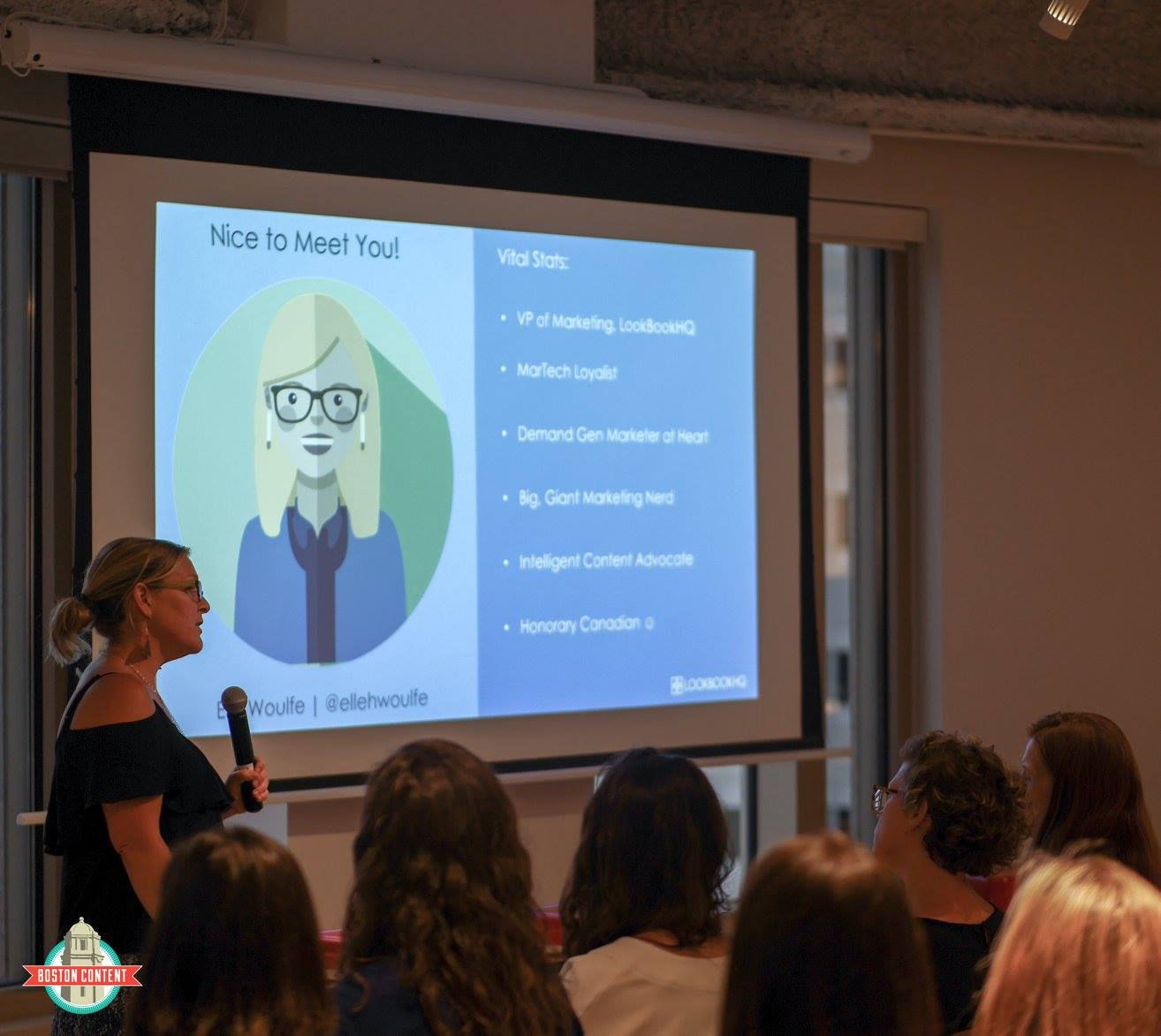
Our first speaker, Elle Woulfe, VP of marketing at LookBookHQ, got the ball rolling by sharing how she gains “Independence From Mediocrity: Creating Fireworks in a World of Content Duds.” Elle drove home how important creating versatile content and repurposing it is — especially when it’s performing well. Because when your content is versatile, whether it’s an infographic, article or e-book (like in Elle’s case), you’re getting the most bang for your buck.

Next up was Brendan Cournoyer, VP of corporate marketing at Brainshark, Inc., who spoke to the importance of diversifying your skillset to be super marketable in his “Start a New Revolution: Content Career Hunting and Skills Selling” chat. His three “gotta have ‘em” skills? Curiosity, versatility, and instinct. He encourages his team at Brainshark to continue diversifying their skills by taking marketing tool and strategy classes online through Marketing Profs.

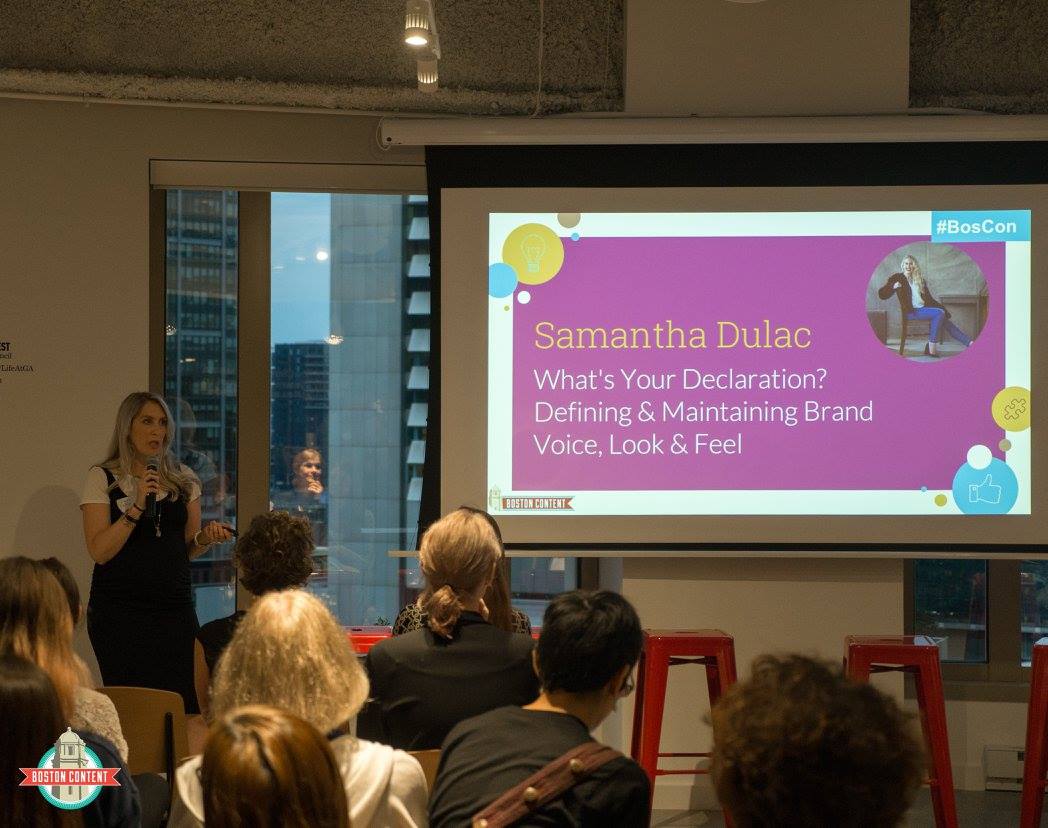
Samantha Dulac, director of brand voice at Rue La La, took a slightly different angle on our theme of versatility. Normally the arbiter of brand voice doesn’t bend or change for anyone, but Samantha shared how sometimes, when the big bosses are really gung-ho about something, your communication and reaction tactics have to be versatile. As a content professional, you have to know when to stick to your guns and when it’s okay to let not-totally-on-brand content go live — especially content that has the lifespan of a mayfly.

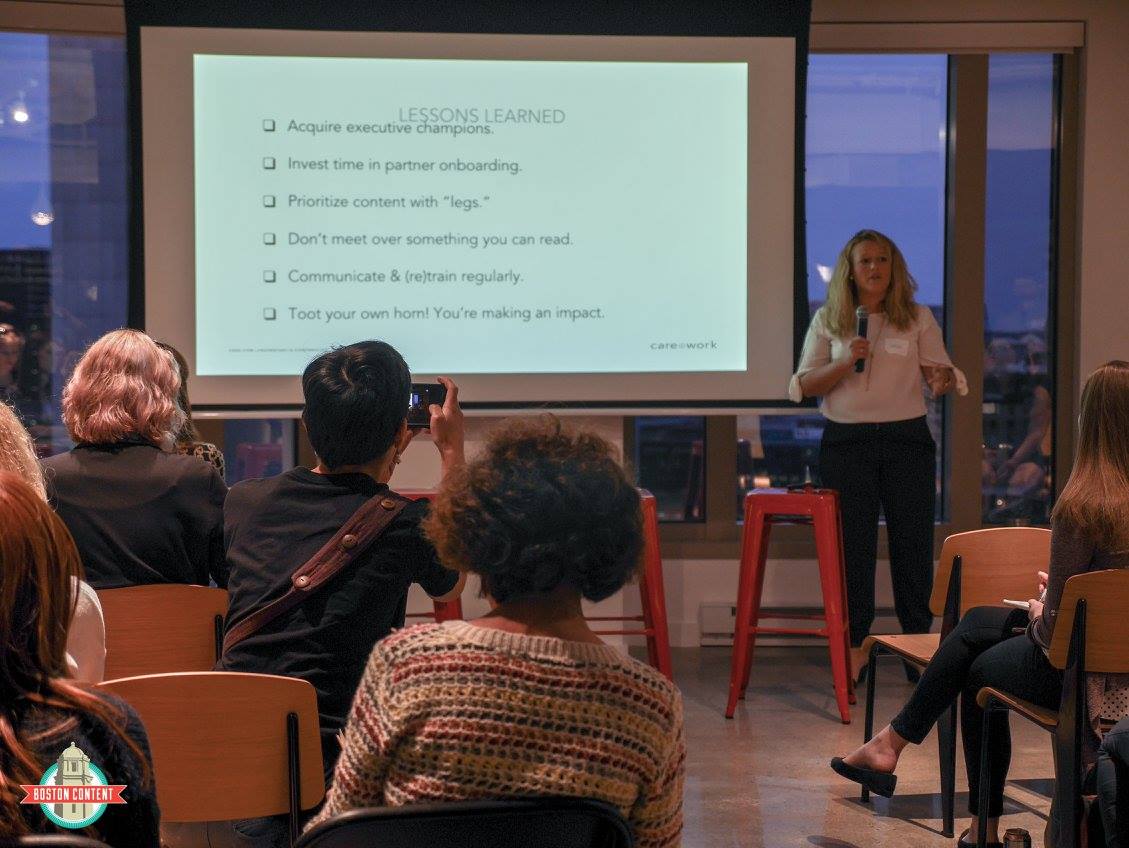
Jess Marble, marketing manager at Care@Work, part of Care.com, strengthened Brendan’s points by regaling us with her tales of being a content army of one — and sharing one heck of a workflow roadmap. Jess literally does it all; from strategy and production to building relationships with her audience and proving her content is working. She could never do all that she does if she wasn’t versatile, and if she wasn’t producing versatile content with legs for days.

So ICYMI, word on the content street is that you and your content have to be versatile. Now go and get out there. Take on a side hustle that will expand your skills, accept a project that’s out of your comfort zone, or continue your professional education at a place like General Assembly (who just happened to be our event host!).

The Next Era of Boston Content

Welcoming New Executive Directors Katelyn Holbrook and Katie Martell


Throughout history, powerful movements have taken on a life of their own, regardless of who’s in charge.

That was evident at Boston Content’s most recent event, which, after a brief hiatus, brought over 200 content professionals back together for an evening of networking, knowledge sharing, and some 90s tunes (naturally). Check out photos from the event.

At this June event, we shared some big news to the group.

The fearless Devin Bramhall and Mike Baker have retired the well-worn capes they donned as Executive Directors of Boston Content. They’ve handed that responsibility over to us: Katie Martell (LinkedIn / Twitter) and Katelyn Holbrook (LinkedIn / Twitter).

As two Boston-born and raised marketers working in various dimensions of the world of content, we are thrilled to be stepping into the role of your new co-executive directors.

We have enormous shoes to fill as the latest dynamic duo to lead this vibrant and engaged community since its founding in 2012 by Jay Acunzo and Arestia Rosenberg. To help us best serve our members, we have recruited some amazing volunteers from the member community. Learn about our new volunteer leadership committee, and Boston Content’s leaders emeritus.

Why are we so excited to be at the helm of Boston Content?

(Oh, you mean besides the fact that this is one of the most enthusiastic and talented group of professionals anywhere, in any city?)

The global content marketing industry is set to reach $313 billion by 2019. Boston is both a remarkable part of that growth figure, and a trailblazer in shaping its future.

There are over 110,000 content professionals in the greater Boston area, with a vast array of agencies, tech firms, and production houses continuing to make this city a leader in the digital economy. In fact, Boston was voted the number 1 startup hub in the US.

Personally, we’re also driven by a few motivating factors in taking on these roles:

  • We want to equip the next generation of content professionals to outdo us in every way.
  • We want to serve the needs of a very diverse industry, filled with many who have now been working in content for years, others who are starting out.
  • We believe in the transformative power of great content in many facets of business and life.

This is for you.

Most importantly, however, are Boston Content’s 1300+ members - yeah YOU (with more joining every day).

It was ultimately the people in this incredible group—the writers, videographers, photographers and designers; the marketers, established executives and entrepreneurs; the uber-creatives and the analytical wonders—that made us so excited for the opportunity to lead Boston Content into its next chapter.

Our mission will, of course, remain the same as Jay and Arestia envisioned it 5 years ago: to provide direction and support so that, as the content industry continues to boom, so, too, do the careers of our members.

Moving forward, we’ll bring this to life with:

  • Wildly actionable and educational events

  • Insightful content of our own reflecting the creativity and smarts of our community

  • Networking for aspiring and current Boston-area content professionals

We’ll also be reinvigorating some past community favorites (including a new-and-improved job board and a not-to-be-missed awards program) and introducing some new ideas along the way.

If you have ideas for what you would like to see from Boston Content, please email BostonContent@gmail.com and be sure to say hello at an upcoming event. Make sure you’re on our mailing list, or connected with us on LinkedIn, Twitter, and now Facebook.
 

Finally, thank you to Devin, Mike, Jay, and Arestia. There’s an oft-used quote about the meaning of life (getting sentimental here):

Plant trees under whose shade you do not expect to sit.

You guys have planted one hell of a tree. We’re honored for the chance to keep it growing.

Yours,
Katie & Katelyn

BostonContent-logo-square.png